 RunFirst
Most beginner running plans assume you can already jog for a minute. The NHS Couch to 5K plan, one of the best-known free plans, opens with a 5-minute walk and then eight 1-minute runs with 90-second walks in between. That's a gentle start for a lot of people.
If you get out of breath on the stairs, it can still feel like too much. Search "can't run for 1 minute" and you'll find plenty of people stuck right there.
This post is for you. It gives you a 4-week plan for the weeks before Couch to 5K: walking first, then jogs short enough that you'll finish them. By the end of it, week 1 of Couch to 5K should feel like the next step instead of a wall.
Before you start: if you have a heart condition, joint problems, another health condition, or you're worried about your health, speak to a doctor first. The NHS says the same before Couch to 5K.
Honestly, my own Day 1 walk felt tough. If yours does too, that's a normal place to begin.
Why "just start running" doesn't work when you're out of shape
A common first attempt goes like this. You go out, run at what feels like a normal running speed, run out of breath within a minute or two, and walk home thinking you're not built for this.
The problem is usually the speed, not you. Running uses more effort than walking. The CDC lists jogging or running as vigorous-intensity activity and brisk walking as moderate. If you're starting from very little activity, jumping straight to the vigorous end is a big ask.
So this plan does two things. It builds a walking base first, and it keeps your first jogs very short.
The 4-week out-of-shape starter plan
| Week | Days | Each session | About how long | Move on when |
|---|---|---|---|---|
| 1 | 5 days | Easy walk | 10 min | 10 minutes feels easy |
| 2 | 5 days | Easy walk, with the last 5 minutes brisk | 15–20 min | You can walk 20 minutes, the last 5 briskly |
| 3 | 3 days, rest day between | 5 min walk, then 6 × (20 sec slow jog + 2 min walk), then 5 min walk | 24 min | You finish every jog and could do one more |
| 4 | 3 days, rest day between | 5 min walk, then 8 × (30 sec slow jog + 90 sec walk), then 5 min walk | 26 min | All 8 jogs feel manageable |
| Next | 3 days, rest day between | NHS Couch to 5K, week 1 | 28.5 min | Follow the NHS plan from here |
A few notes on the table:
- "Brisk" means you can talk but not sing. That's the NHS's own test for a brisk walk.
- "Slow jog" means barely faster than walking. If you can't get a few words out, slow down.
- Weeks 3 and 4 use 20-second and 30-second jogs on purpose. They sit between "walking only" and the 1-minute jogs in Couch to 5K week 1.
- The "Move on when" column matters more than the week number. Repeat any week as many times as you need. The NHS says Couch to 5K itself can take 9 weeks or longer, and the same goes for this plan.
This is a starting framework I put together for beginners, not a medical program. If something hurts or doesn't feel right, stop.
Why start with only 10 minutes?
Because 10 minutes is short enough to say yes to on a bad day, and it still counts. The NHS says a brisk 10-minute daily walk has lots of health benefits and counts towards your 150 minutes of weekly exercise. The CDC puts it simply: some physical activity is better than none.
Week 1 is mostly about getting used to going out the door. Fitness comes along with it.
For me, that means heading out in the morning, around 7 AM.
The bad-day rule
You'll have days when the plan feels like too much. On those days, do a 10-minute walk and call it done.
You don't make it up later or add extra the next day. You just keep the habit going. When most of the work is getting out the door, a short session beats a skipped one.
Rest days are part of the plan
In weeks 3 and 4, leave a day between jog sessions. The NHS plan does the same and says rest days give your body time to recover, help prevent injury, and are just as important as the runs themselves.
An easy walk on a rest day is fine. Just keep it easy.
Make it easier to start than to scroll
Often the walk itself is the easy part. Getting off the couch with a phone in your hand is harder.
A few things that help:
- Pick a time and stick to it. After work, before breakfast, after dinner. Same time each day.
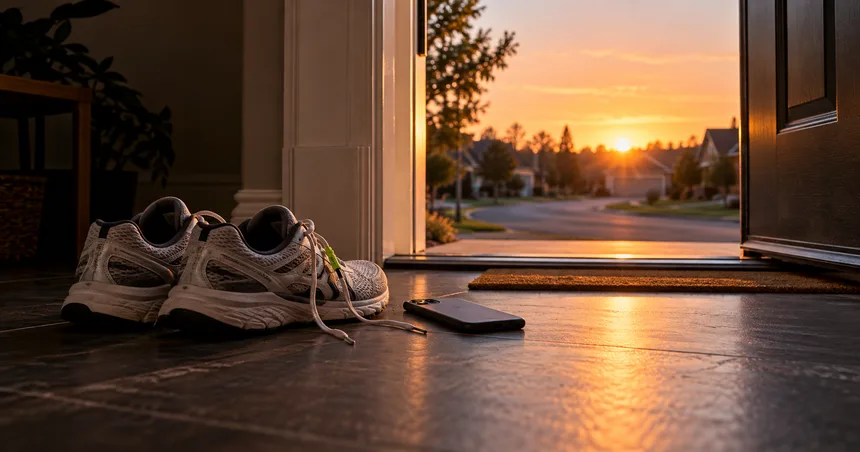
- Shoes by the door. One less decision.
- Phone in your pocket, not your hand. Use it for a timer, then put it away.
- Swap a scroll slot for a walk slot. If you usually scroll after dinner, walk then instead.
Before RunFirst, most of my scrolling was Instagram and, honestly, chatting with Claude.
What if I hate running?
Plenty of people who say they hate running have only tried it too fast. A 20-second jog at near-walking speed feels very different from a gym-class mile.
Give the slow version a few weeks. If you still don't like it, brisk walking is still good exercise and counts towards your weekly activity. You don't owe anyone a 5K.
Where RunFirst fits in
I built RunFirst for people starting from exactly here. It's an iPhone app (iOS 17+) with a 90-day plan that starts with a 10-minute walk, the same first step as the table above, with rest days built in.
It keeps the apps you pick, like Instagram, YouTube or Netflix, locked until you walk or run. Every kilometre you cover earns screen time. You also get Run Reels, Day and Week Cards to see your progress, Fight mode and a leaderboard. I'm sharing my own Day 1 to 90 here on the blog.
I'm on Day 1 of my 90 as I write this, so I'm starting right alongside you.
If you want a nudge out the door, the yearly plan starts with a 7-day free trial and then costs $29.99 a year. There's also a weekly plan at $4.99. The plan above works without it, too.
FAQ
How do I start running if I'm really out of shape?
Start with short, easy walks of about 10 minutes and build up to 20 minutes with some brisk walking. Then add very short, slow jogs of 20–30 seconds with walking breaks, three days a week with a rest day between.
Is it normal to not be able to run for 1 minute?
Yes, it's a common starting point. Make the jogs shorter (20–30 seconds), make them slower, and take longer walking breaks. Build up week by week.
How long should a beginner run for?
In this plan, the jogging bits are 20–30 seconds at first, inside a session of about 25 minutes that's mostly walking. Week 1 of NHS Couch to 5K uses 1-minute runs with 90-second walks, for a total of 28.5 minutes including warm-up and cool-down.
How often should a beginner run?
Three times a week, with a rest day in between. That's the schedule the NHS Couch to 5K plan uses.
Should I see a doctor before I start running?
If you have a health condition or you're worried about your health, yes, speak to a doctor first. Stop if something hurts or doesn't feel right.
Drafted with AI assistance from research notes; fact-checked and edited by Devesh Babbar.